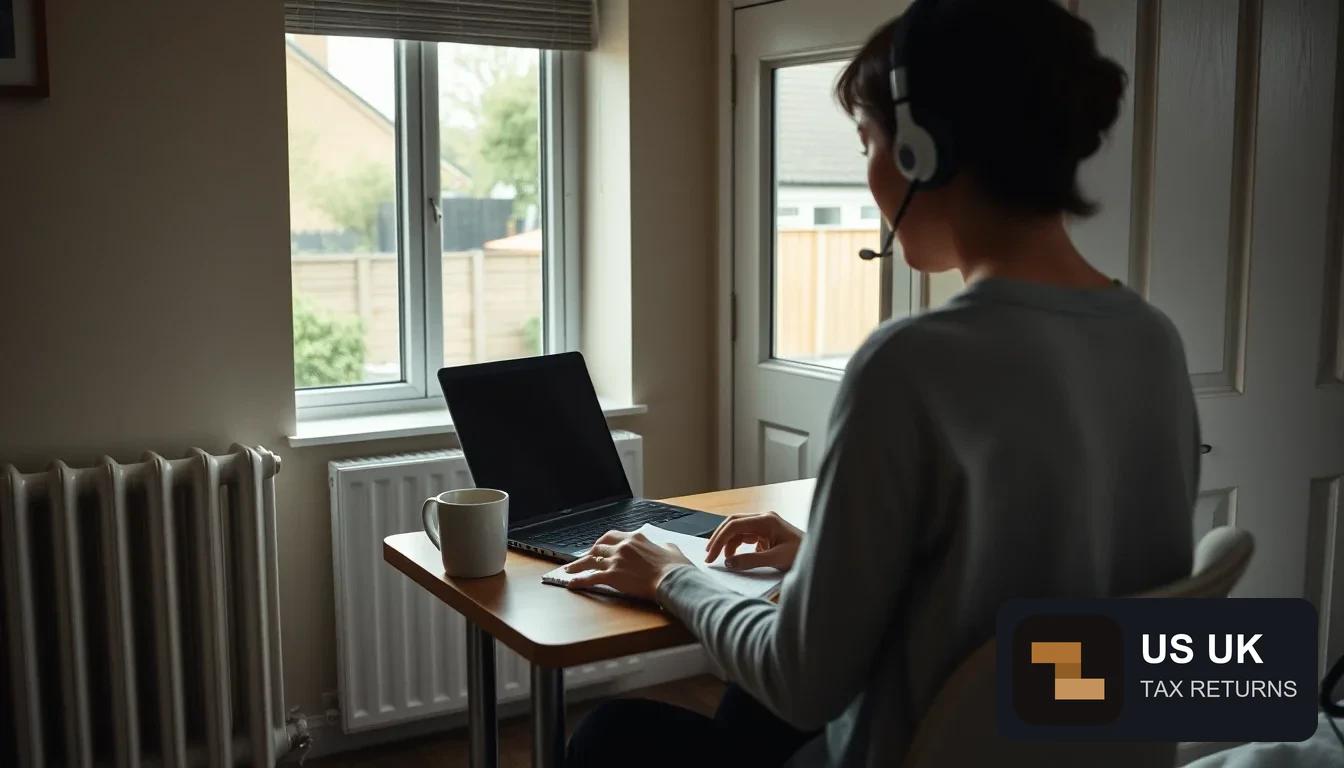
For an American employee, the home office deduction an expat in the UK might hope for has gone on both sides. The IRS does not let most employees deduct unreimbursed work costs on Form 1040 (opens the official IRS page in a new tab), and HMRC stopped employee claims for extra household costs from 6 April 2026. What survives is a tax-free payment from a UK employer, which the US may still tax, and the business-use-of-home rules for the self-employed.
This post is for US citizens and green card holders working from a spare room or kitchen table in Britain, whether on a UK payroll, for a US company, or on their own account. It goes deeper on one question than our guide to US and UK tax returns for Americans in the UK. It covers the UK employee rules before and after April 2026, employer payments, the US position for employees and freelancers, a decision table and a worked example.
Can an American employee claim a home office deduction in the UK
Not for 2026/27. HMRC's manual says that from 6 April 2026 an employee can no longer deduct additional household expenses of working at home. For earlier years, relief was available only to employees who had to work from home, and claims for those years can still be made within HMRC's normal time limits.
The old test was narrow and still governs any claim for a past year. HMRC's guidance allowed relief where the job itself required home working, for example because the employer had no office or the role required living far from one. Choosing to work from home did not qualify, even where the contract allowed it or the office was full on the day. Hybrid working by preference was outside the relief.
Only the extra cost of the work counted: more heating and electricity for the work area, or business calls. Costs that would be paid anyway, such as rent or a broadband contract also used privately, did not. A claim for a past year is made online with evidence that home working was required, or through the Self Assessment (opens the official GOV.UK page in a new tab) return where the employee already files one. Our UK Self Assessment work includes these claims on the SA100.
What a UK employer can still pay you tax-free
A UK employer can still make tax-free homeworking payments. HMRC's manual says the employer exemption for certain homeworking payments continues after April 2026, and it warns readers not to confuse it with the end of employee deductions. The payment must cover additional household costs of an employee who regularly works at home under arrangements agreed with the employer.
The employer can pay up to a weekly limit set by HMRC without asking for receipts, or more where it can show the payment does not exceed the employee's actual extra costs. Anything above the limit or the evidenced cost is earnings and goes through PAYE (opens the official GOV.UK page in a new tab) with Class 1 National Insurance. Equipment the employer provides falls under separate rules in the same HMRC guidance.
HMRC frames the conditions for this exemption around the agreed arrangement and regular home working, not the old question of whether the job required it. For an employee on a UK payroll, asking whether the employer offers the payment is now the only UK route to relief for home costs. The exemption sits in HMRC's guidance for employers, so the request goes to payroll or HR rather than to HMRC.
- A written or agreed homeworking arrangement with the employer
- Regular work at home under that arrangement, not occasional days
- Payment within HMRC's weekly limit, or backed by evidence of actual extra costs
- Any excess run through payroll as taxable pay
- Employer-provided equipment considered separately from the household cost payment
Can you deduct home office costs on Form 1040 as an employee
No, for most employees. The IRS says you can no longer claim miscellaneous itemized deductions subject to the floor based on adjusted gross income, which is where unreimbursed employee expenses used to sit. The suspension was originally due to lapse after 2025, but the IRS draft of Publication 529 for 2026 still says the same, following legislation passed in 2025.
The exceptions are narrow and none of them fits an ordinary office worker. They are Armed Forces reservists, qualified performing artists, fee-basis state or local government officials and employees with impairment-related work expenses, plus certain educator expenses. The Schedule A instructions (opens the official IRS page in a new tab) for 2025 list the other itemized deductions allowed, and an employee's home office is not among them. The IRS publication on business use of a home also answers no for anyone using the space as an employee.
That holds whoever the employer is. A US citizen working from a flat in Leeds for a Chicago company is in the same position as one employed by a British bank. Where the employer is in the US, Form 1040 shows the salary from a Form W-2. Where it is in the UK, the salary is reported from UK payroll records converted to dollars. Our post on working in the UK for a US employer covers the filing side.
Is a UK homeworking allowance taxable on your US return
Usually yes. A payment HMRC exempts is not automatically excluded from US income. The IRS guide to taxable and nontaxable income (opens the official IRS page in a new tab) sends employer allowances to the reimbursement rules in Publication 463, and a flat weekly payment made without the employee accounting for actual costs fails those rules, so it counts as pay.
Publication 463 sets three conditions for an accountable plan: the expenses must have a business connection, the employee must account for them to the employer within a reasonable period, and any excess must be returned. A flat homeworking allowance meets neither of the last two, so the US treats it as part of wages. Where an employer reimburses evidenced extra costs, the answer is less clear, and we look at the arrangement before deciding.
In practice the amounts are small, but they belong on the Form 1040 with the salary. The allowance is pay for work done in the UK, so it is foreign earned income for the foreign earned income exclusion (opens the official IRS page in a new tab) and general category income for the foreign tax credit. Because the UK charges no tax on it, it slightly dilutes the UK tax rate on that category, which rarely changes the result on Form 1116.
How the self-employed home office deduction differs
A self-employed American can still claim on both returns. The US allows a deduction for business use of a home on Schedule C (opens the official IRS page in a new tab), worked out on Form 8829 or by the simplified method. The UK lets a sole trader deduct the business share of home costs, or use HMRC's flat rate once home working passes a monthly hours threshold.
The US tests are strict. The space must be used regularly and exclusively for the business, and must be the principal place of business or a place used to meet clients. A dining table used for family meals fails the exclusive use test. The simplified method multiplies an allowable area by a prescribed rate, allows no depreciation on the home, and does not let you use a carryover of disallowed actual expenses from an earlier year in that year.
The UK apportions home costs by business use, so a room also used privately can support a UK claim while failing the US exclusive use test. A lower US profit also reduces self-employment tax on Schedule SE (opens the official IRS page in a new tab), although most self-employed people living here pay UK National Insurance instead under the totalization agreement (opens the official SSA page in a new tab). Our post on being self-employed in the UK as a US citizen covers the wider picture. The table below sets out each case.
- Employee who chooses home working, 2026/27: no UK claim, no US deduction; employer payment only
- Employee required to work at home, years to 2025/26: UK relief claimable; still no US deduction
- Employee paid a UK homeworking allowance: exempt from UK tax, usually US wages
- Self-employed, room used only for the business: UK business share and US Schedule C deduction
- Self-employed, room also used privately: UK claim possible; US exclusive use test usually fails
A worked example and a checklist for both returns
Take a US citizen employed by a London consultancy, working from home three days a week by choice, and her husband, a US citizen freelance illustrator in the same house. She never qualified for the old UK relief, because her office stays open to her. From 2026/27 her employer pays the exempt weekly homeworking amount through payroll. She keeps the payslips showing it.
On her US return the allowance is added to her salary, converted at the rate used for the rest of her pay, and covered by the foreign tax credit along with it. She has no US deduction to claim. Her husband works in a box room used only for illustration, which is his principal place of business, so he can take the home office deduction on Schedule C as well as the business share of costs on his UK return.
Had either of them received a UK refund for an earlier year, the Form 1116 instructions (opens the official IRS page in a new tab) say a refund of foreign tax already credited means filing an amended return to reduce the credit, which our Form 1040-X page explains. Our individual tax returns and cross-border tax work runs both returns together, and the guide for Americans in the UK sets out the wider rules. Before filing, check these points:
- Are you an employee or self-employed for the work done at home
- For a past-year UK claim, was home working a requirement of the job
- Did your employer pay a homeworking amount, and was it flat or reimbursed
- Has that payment been added to US wages and converted with the salary
- For self-employment, is the space used only for the business
- Did any UK refund for an earlier year reduce foreign tax already credited
General information, not advice. The right answer depends on your circumstances and the tax year concerned.