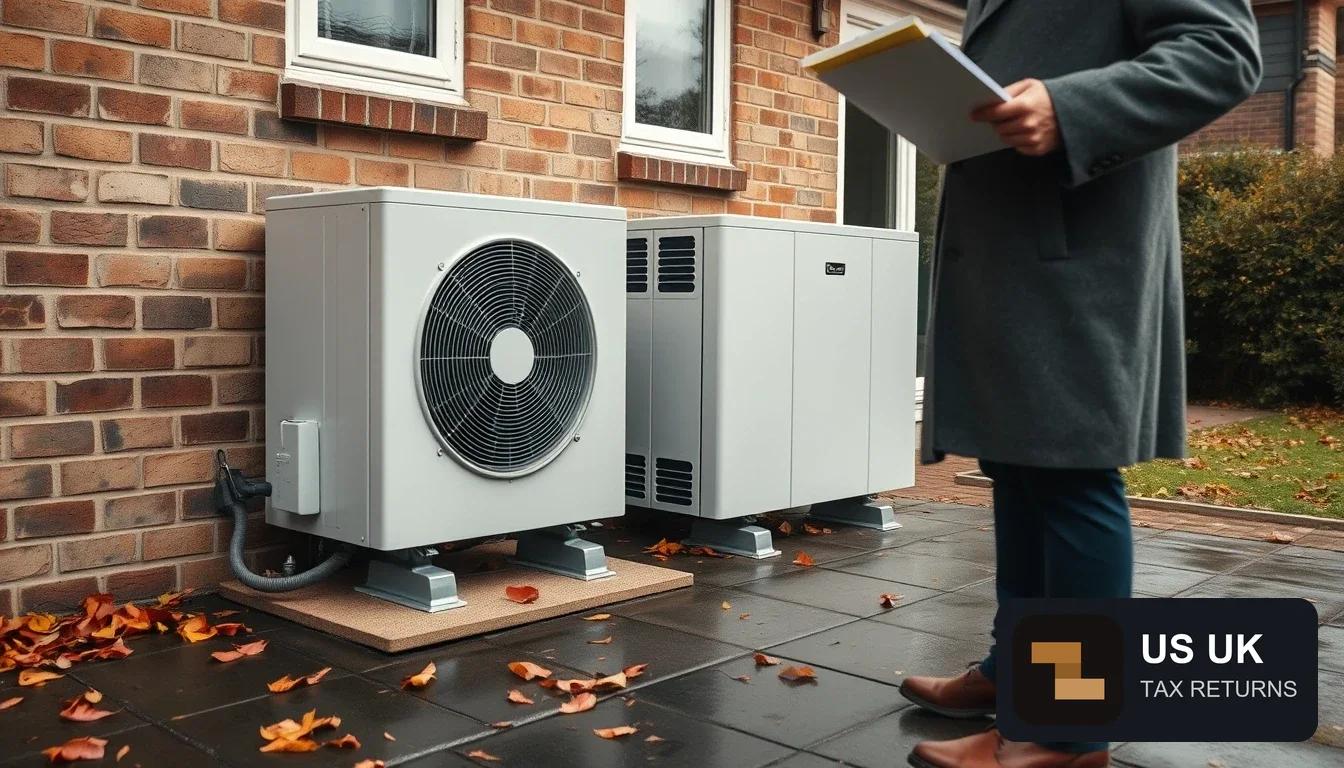
On US energy credits in 2027 the answer is short: a heat pump, solar array or new insulation fitted to a UK home earns no US credit on the 2026 return. The residential clean energy credit and the energy efficient home improvement credit both required a home located in the United States, and the One Big Beautiful Bill Act ended both after 31 December 2025. The useful work now sits on the UK side and in your records.
This post is for US citizens and green card holders who own a home in Britain and are adding low-carbon heating, panels or insulation. It goes deeper on one narrow question than our guide to US and UK tax returns for Americans in the UK. It covers why the US credits are closed, what the UK schemes provide, how a grant or export payment may sit on your Form 1040, and which papers protect you when the house is eventually sold.
Can you claim US energy credits in 2027 for a UK home
No. Each credit fails twice for a British property. The IRS limited both to a home located in the United States, and the 2025 legislation closed them: the clean energy credit for expenditures made after 31 December 2025, the home improvement credit for property placed in service after that date. A 2026 installation in Leeds or Kent qualifies for neither.
The location rule was there before the repeal. The IRS instructions to Form 5695 describe the clean energy credit as covering property for use in your home located in the United States, and the home improvement credit as covering a home located in the United States that you used during the year. A UK house, flat or cottage never met either test, however green the equipment.
The termination wording matters for anyone who had work straddling the year end. IRS questions and answers on the 2025 changes say the clean energy credit is not allowed for expenditures made after 31 December 2025, and that an expenditure counts as made when original installation is completed. Paying a deposit in December 2025 does not rescue panels finished in January 2026. The home improvement credit is not allowed for property placed in service after 31 December 2025.
- Work on a UK home in any year: no credit under either section
- Work on a US home completed in 2026: no credit, because both credits have ended
- Clean energy credit from a US home in 2025 that was too large to use: the unused part carries to the 2026 return under the Form 5695 instructions
- Any other 2026 or 2027 home energy spending: look to UK schemes and to your basis records
What do the UK schemes offer for heat pumps and solar
Three are relevant to a homeowner. The Boiler Upgrade Scheme gives a grant towards replacing fossil fuel heating in England and Wales. Installed energy-saving materials carry a zero rate of VAT for a limited period. The Smart Export Guarantee pays you for surplus solar electricity sent to the grid in Great Britain.
GOV.UK describes the Boiler Upgrade Scheme as a grant towards replacing oil, gas, electric or LPG heating with a heat pump or, in some rural off-grid homes, a biomass boiler. You must own the property, which can include a second home or a rental. The installer applies to Ofgem on your behalf, and the grant is taken off the price on your quotation and invoice. Scotland runs its own loan and grant options, and the Northern Ireland scheme has closed.
The VAT relief appears in HMRC's notice on energy-saving materials. It covers installation of insulation, air and ground source heat pumps, solar panels, batteries and heating controls in homes, so qualifying installation work can be invoiced without VAT, subject to the conditions the notice sets. Materials bought from a retailer and fitted yourself stay standard-rated. The notice gives a fixed end date in spring 2027, after which the reduced rate returns, so a project planned for later in 2027 should check timing first.
Is a Smart Export Guarantee payment taxable
In the UK, often not. HMRC's Business Income Manual explains an income tax exemption for an individual's income from selling electricity generated by a domestic microgeneration system, subject to conditions. On the US side no exemption exists for UK export income, and the treatment depends on the facts, so it needs looking at rather than assuming.
HMRC's conditions, drawn from section 782A of the Income Tax (Trading and Other Income) Act 2005, are that the system is installed at or near domestic premises the individual occupies, and that the individual intends the electricity generated not to substantially exceed what is used there. An export payment is a payment for electricity sold, which is why HMRC's exemption is the starting point for a household array. Suppliers set their own tariffs, and you need a meter that records half-hourly exports and a certified installation.
The US position is less settled. Publication 525 (opens the official IRS page in a new tab) lets you exclude subsidies from public utilities for energy conservation measures in a dwelling, which is a different thing from being paid for power you sell. We are aware of no IRS guidance written for British export tariffs. Keep each statement, convert receipts using the IRS yearly average exchange rates (opens the official IRS page in a new tab) or the spot rate on the day, and ask whether they belong on the return.
Does a Boiler Upgrade Scheme grant count as US income
It depends, and the IRS has not addressed the UK scheme. The US exclusion in Publication 525 covers subsidies paid by public utilities. A government grant administered by Ofgem and deducted by the installer is not obviously a utility subsidy, so the answer turns on how the grant is structured and what it pays for.
In practice most homeowners never receive the money. The installer claims it and you pay a lower invoice. That fact matters for basis, because what you add to the cost of your home is normally what you actually paid. Publication 551 (opens the official IRS page in a new tab) says the basis of property is reduced by any excluded energy conservation subsidy, and IRS guidance on selling a home tells owners to subtract energy credits or subsidies that effectively paid them back for improvements already counted.
The safe course is to record the gross price, the grant shown on the invoice and the net sum you paid, so that whichever treatment applies can be supported later. Our individual tax returns team reviews grants of this kind when we prepare the US return, and our tax planning work covers larger renovations before they start.
How do green improvements affect the US gain when you sell
They can reduce it. A heat pump, loft or wall insulation and fitted solar panels are generally capital improvements, which increase the US cost basis of your home. A higher basis means a smaller gain before the section 121 exclusion is applied, which matters most for owners whose gain could exceed the exclusion.
Section 121 lets you exclude part or all of the gain on a main home if you meet ownership and use tests over the years before the sale, as IRS Topic no. 701 on selling your home (opens the official IRS page in a new tab) sets out. It can apply to a main home abroad, but it is not the same as UK private residence relief. A sale that is free of UK tax under HMRC's rules on selling your home (opens the official GOV.UK page in a new tab) can still produce a US gain.
Currency is the other half of the calculation. Each improvement is translated into dollars when it is paid for, and the sale price when the house is sold, so a falling or rising pound changes the result even when the sterling figures look flat. Our post on selling a UK home as a US citizen covers that arithmetic, and sterling mortgages and currency gains covers the loan side.
What records should you keep for a UK energy upgrade
Keep everything that proves cost, date and grant. Publication 551 says you must keep accurate records of all items affecting basis. For a UK project that means the quotation, invoice, proof of payment, any grant shown, the certification paperwork and the export statements, held until well after the home is sold.
Take a US citizen working as a hospital pharmacist in Bristol who owns the family home with her British husband. In 2026 she replaced the gas boiler with an air source heat pump under the Boiler Upgrade Scheme, topped up the loft insulation and added solar panels with a battery, then signed up to an export tariff. She claims nothing on her 2026 US return, and builds a basis file instead.
Her steps are simple. She keeps the zero-rated invoices, records the dollar cost on each payment date, and keeps her half of the export statements with her UK papers. If she and her husband sell in ten years, the file shows the US basis without anyone reconstructing it from bank statements. Our cross-border property service works from files like hers, and the wider annual routine is in our guide for Americans in the UK.
- Installer quotation and final invoice, showing the grant deducted and VAT charged
- Proof of each payment, with the date and sterling amount
- Dollar value of each payment at the exchange rate you have chosen to apply
- Certification documents for the heat pump and the solar installation
- Every export tariff statement, kept by tax year and by calendar year
- A note of who owns the home and in what shares, if it is held jointly
General information, not advice. The right answer depends on your circumstances and the tax year concerned.